
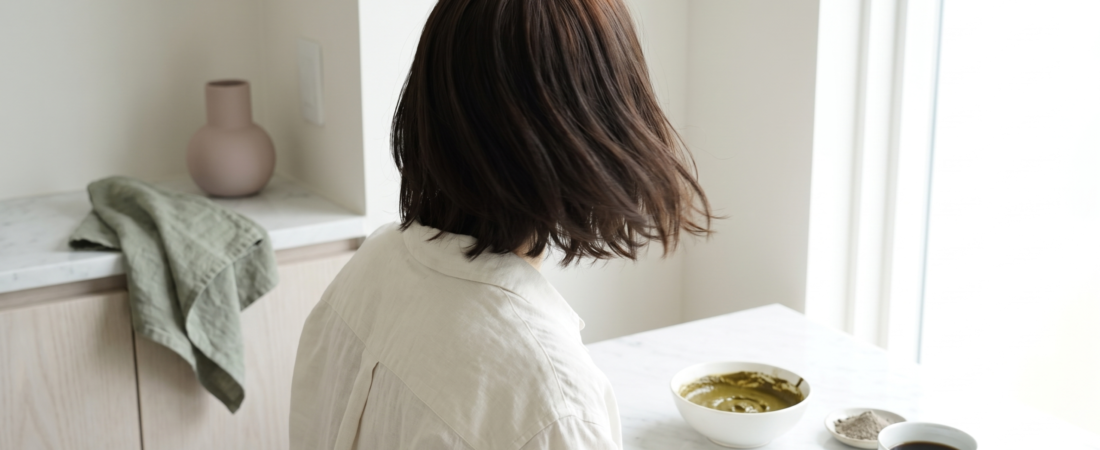
An easy 4:1:1 herbal hair dye recipe for women who want a gentler, more mindful approach to covering gray hair.
There comes a morning when we look in the mirror and notice something familiar.
A few strands of gray hair have appeared along our part. The roots around our temples seem a little lighter than they were just a few weeks ago.
Didn’t we just color our hair?
For many women in their 40s, 50s, and beyond, covering gray hair gradually becomes part of their regular beauty routine.
But as the weeks between coloring sessions seem to get shorter, new questions begin to arise.
Is coloring my hair this often good for my scalp? Why does my hair feel drier than it used to? Is there a more natural way to maintain my hair color?
These questions have led many women to explore traditional plant-based hair coloring.
One popular approach combines henna, amla, and coffee.
Today, we’re exploring how these ingredients work, how to prepare a simple 4:1:1 herbal hair coloring mixture at home, and what results you can realistically expect.
Because caring for our hair as we age isn’t just about hiding gray strands. It’s about finding a beauty routine that feels right for us.
1. Why Gray Hair Becomes More Noticeable in Midlife
Gray hair develops when the pigment-producing cells in our hair follicles gradually produce less melanin.
Genetics and aging are the primary factors influencing when and how quickly our hair turns gray.
For many women, midlife also brings changes in hair texture, thickness, and moisture.
Hair that once felt silky may become drier. The scalp may feel more sensitive, and new gray roots can become noticeable sooner than expected.
This is why frequent hair coloring can feel increasingly complicated.
Some women embrace their natural silver hair beautifully. Others prefer maintaining their familiar brunette shade.
Neither choice is more beautiful than the other.
The important thing is finding a method that suits your hair, your lifestyle, and your personal sense of beauty.
2. Understanding Henna, Amla, and Coffee
Before trying a homemade herbal hair dye, it’s helpful to understand what each ingredient actually does.
Henna: The Natural Coloring Ingredient
Henna comes from the leaves of the Lawsonia inermis plant.
For thousands of years, it has been used to color hair and skin.
Henna contains a natural pigment called lawsone, which binds to the keratin in hair.
Unlike many conventional permanent hair dyes, pure henna does not rely on an oxidative bleaching process to deposit color.
However, pure henna produces warm shades.
On gray or white hair, the result is usually copper, orange-red, or reddish brown.
On naturally dark hair, henna may create subtle reddish highlights rather than dramatically changing the original color.
Important: Pure henna alone cannot reliably turn gray hair dark brown or black.
Amla: A Traditional Ingredient for Balancing Warm Tones
Amla, also known as Indian gooseberry, is a fruit traditionally used in Indian hair care.
It is commonly sold as a finely ground powder.
Amla contains naturally occurring acids and is often mixed with henna to influence the coloring mixture.
In particular, amla is used to help create cooler-looking tones, especially when henna is combined with indigo.
One commonly recommended ratio is:
100 grams of henna + 25 grams of amla
This is a 4:1 ratio by weight.
However, amla does not independently turn gray hair black or restore lost hair pigment.
Its role is to support and modify the herbal coloring mixture.
Coffee: Does It Really Make Henna Darker?
Coffee is a popular addition to homemade hair dye recipes.
Many traditional beauty tips suggest that adding coffee to henna creates a deeper brown color.
But there is an important distinction between traditional recipes and scientifically established results.
There is currently insufficient evidence that adding coffee to henna produces lasting dark brown hair color.
Coffee does not function like henna or indigo as a permanent botanical hair dye.
For this reason, coffee should be considered an optional ingredient rather than a reliable darkening agent.
Women with caffeine sensitivity or easily irritated scalps may prefer to leave it out altogether.
3. DIY Henna, Amla, and Coffee Hair Dye Recipe
One traditional homemade mixture uses henna, amla, and coffee in a 4:1:1 ratio.
This recipe is simple to prepare and may appeal to women who enjoy experimenting with natural beauty ingredients.
However, it is important to understand that this is a traditional home recipe, not a scientifically validated formula for achieving a particular hair color.
Ingredients
| Ingredient | Amount | Purpose |
|---|---|---|
| Pure henna powder | 4 tablespoons | Provides the primary reddish-orange hair pigment |
| Amla powder | 1 tablespoon | Helps modify the mixture’s tone |
| Plain instant coffee | 1 tablespoon | Optional traditional ingredient |
| Lukewarm water | As needed | Creates a smooth paste |
Mixing Ratio: Henna : Amla : Coffee = 4 : 1 : 1
This ratio is based on tablespoons, not weight.
Because the powders have different densities, measuring them by volume is not identical to a 4:1:1 ratio by weight.
If you prefer a simpler botanical mixture, begin with henna and amla alone.
For a more precisely measured recipe, a commonly used starting point is 100 grams of henna and 25 grams of amla.
Step 1: Prepare the Herbal Mixture
Place the henna and amla powders in a clean glass or ceramic bowl.
If using coffee, dissolve the instant coffee in a small amount of warm water before adding it.
Gradually pour in lukewarm water and stir until the mixture forms a smooth paste.
The consistency should resemble thick yogurt.
It should spread easily through the hair without dripping excessively.
Avoid making the mixture too watery.
Step 2: Allow the Henna Dye to Release
Cover the bowl and allow the mixture to rest according to the henna manufacturer’s instructions.
Different henna products require different preparation times.
Some need several hours for optimal dye release, depending on the product, acidity, and room temperature.
Rather than automatically leaving the mixture overnight, follow the instructions provided with your chosen henna powder.
This helps prevent inconsistent coloring results.
Step 3: Apply the Paste to Clean Hair
Before coloring, make sure your hair is free from heavy styling products and excess oil.
Wear protective gloves and divide your hair into manageable sections.
Begin applying the paste to areas where gray hair is most visible.
For many women, these areas include the hairline, temples, and parting.
Work carefully to distribute the paste evenly.
If this is your first time using henna, perform both an appropriate skin patch test and a strand test before coloring your entire head.
A strand test helps you see the actual color that develops on your hair.
Step 4: Let the Color Develop
Some traditional recipes suggest leaving henna mixtures on the hair for approximately two hours.
However, the correct processing time depends on the specific product and formula.
Always follow the manufacturer’s recommended instructions.
Leaving a product on longer than recommended does not guarantee better results and may increase the risk of irritation.
Step 5: Rinse and Observe the Color
Rinse your hair thoroughly with lukewarm water until the remaining herbal paste is removed.
Be patient with this step, as henna powder can take time to rinse out completely.
The color may continue to change slightly over the following days.
Allow the shade to settle before deciding whether another application is necessary.
Remember that botanical hair coloring is not as predictable as conventional salon coloring.
The final result depends on your original hair color, the percentage of gray hair, and the ingredients used.
4. Can Henna, Amla, and Coffee Really Cover Gray Hair?
This is probably the most important question.
Yes, henna can color gray hair. But the result may not be the shade you expect.
Pure henna generally produces warm copper or reddish tones.
When your hair is naturally dark with only a few gray strands, the colored grays may resemble soft auburn highlights.
However, if much of your hair is white or gray, the resulting color may appear noticeably orange or copper.
Adding amla may influence the tone, but coffee is not a dependable solution for creating dark brown hair.
What If You Want Dark Brown Hair Instead?
For women who prefer rich brown or nearly black hair, another botanical ingredient is worth exploring.
Indigo powder.
Indigo is a plant-derived colorant that can be used with henna to produce darker shades.
Depending on the proportions and application process, henna and indigo mixtures can create brown, dark brown, or nearly black results.
Some women with significant gray hair prefer a two-step process:
- Apply henna to establish a warm base color.
- Follow with an appropriately prepared indigo application to achieve a darker shade.
This process requires different preparation instructions from the henna, amla, and coffee recipe.
Always use products specifically intended for hair coloring and follow their instructions carefully.
If your goal is natural-looking dark brown coverage, researching henna and indigo may be more useful than simply adding extra coffee.
5. How Often Should Women Over 40 Color Their Gray Hair?
One of the challenges of midlife hair care is managing new root growth.
As gray hair grows, the difference between colored hair and natural roots becomes more visible.
With henna, repeated applications can also gradually deepen the color of previously dyed sections.
For this reason, applying henna only to new root growth may be preferable to coloring the entire length every time.
The ideal schedule depends on several factors, including:
- How quickly your hair grows
- The percentage of gray hair
- Your preferred hair color
- Your scalp’s sensitivity
- The type of herbal coloring products you use
There is no universal rule that women must color their hair every two, three, or four weeks.
If your scalp feels uncomfortable, itchy, or irritated, stop coloring and evaluate the cause before applying another product.
Sometimes the healthiest beauty routine is simply the one that allows us to slow down.
6. Important Safety Tips Before Trying Herbal Hair Dye
Natural does not automatically mean safe.
Even plant-based ingredients can trigger allergic reactions or skin irritation.
Before using any hair dye, carefully read the ingredient list and manufacturer’s instructions.
The U.S. Food and Drug Administration recommends performing a skin patch test before hair coloring and checking for reactions over 48 hours.
Follow the product’s specific patch-testing directions every time you color your hair.
Be Especially Careful If:
- You have experienced allergic reactions to hair dye.
- Your scalp is irritated, inflamed, or damaged.
- You have recently bleached, relaxed, or permed your hair.
- You have a known allergy to PPD.
- You are using a pre-mixed product with ingredients you cannot identify.
If you have recently undergone a chemical hair treatment, follow the applicable waiting-period guidance and consult a qualified stylist when uncertain.
Watch Out for Products Labeled “Black Henna”
Not all products marketed as natural henna contain only plant ingredients.
Some products labeled “black henna” may contain added chemical dyes, including para-phenylenediamine, commonly known as PPD.
PPD can cause significant allergic reactions in susceptible individuals.
To reduce unnecessary risks, choose products with transparent ingredient lists and avoid unidentified additives.
If you experience burning, swelling, severe itching, or a rash, stop using the product. Seek medical attention for a significant reaction.
Taking care of your scalp is always more important than achieving a particular hair color.
7. Turning Gray Hair Care Into a Mindful Self-Care Ritual
There is something beautiful about changing the way we approach our daily routines.
Perhaps hair coloring doesn’t always have to feel like another task on our endless to-do list.
Imagine a quiet Saturday morning.
Soft sunlight enters through the window.
A cup of warm herbal tea sits beside you.
Your favorite music plays gently in the background while you take a little time to care for yourself.
Instead of rushing to cover every gray strand, you begin to appreciate the simple ritual of looking after your hair.
You become more curious about ingredients.
You pay closer attention to what feels comfortable on your scalp.
And gradually, you discover that beauty in midlife is less about trying to look younger and more about feeling comfortable with who you are becoming.
Henna and amla offer one possible approach to botanical hair coloring.
They may not be the perfect solution for everyone, and they do not promise salon-perfect results.
But for women who enjoy exploring traditional beauty practices, they can be part of a thoughtful, personalized hair care routine.
Growing older doesn’t mean losing our beauty. Sometimes it means discovering a quieter, more confident version of it.
And perhaps that is one of the loveliest things about midlife.
Frequently Asked Questions About Henna and Gray Hair
Does mixing coffee with henna turn gray hair black?
No. Coffee is not a reliable permanent hair dye. Adding it to henna does not guarantee black or dark brown results. Pure henna typically produces orange-red or copper tones on gray hair.
What is the best henna-to-amla ratio?
A commonly recommended starting ratio is four parts henna to one part amla by weight. For example, 100 grams of henna can be combined with 25 grams of amla. Follow the product manufacturer’s directions for the most consistent results.
Can amla reverse gray hair naturally?
There is no reliable scientific evidence that applying amla powder can permanently reverse age-related gray hair or restore melanin production in hair follicles.
Is henna safer than regular hair dye?
Pure henna uses a different coloring mechanism from many conventional permanent dyes, but it is not necessarily safe for everyone. Botanical ingredients can still cause allergic reactions, and some commercial henna products contain additional chemicals.
Can I use henna on previously colored hair?
Some pure botanical dyes can be used on previously colored hair, but the results may vary. Always check product instructions and perform a strand test, particularly if your hair has been bleached or chemically treated.
How can I achieve dark brown hair naturally?
Henna combined with indigo is generally more suitable for achieving darker botanical hair colors than henna mixed with coffee. The exact result depends on your starting hair color, proportions, and application process.
Final Thoughts
Gray hair is a natural part of aging, but how we choose to care for it is entirely personal.
Whether you embrace your silver strands or prefer a beautifully maintained brunette shade, the best approach is one that makes you feel confident and comfortable.
For women exploring natural hair coloring, henna and amla may be worth learning about.
Start slowly, choose quality ingredients, and always prioritize safety.
Above all, remember that caring for your appearance should never feel like a race against time.
It can simply be another gentle way of caring for yourself.
Because beauty after 40 is not about becoming someone else. It’s about feeling more at home in your own skin.
References and Further Reading
- U.S. Food and Drug Administration: Hair Dyes
- FDA: Cosmetics Safety Q&A on Hair Dyes
- FDA: Henna and Black Henna Safety Information
Disclaimer: This article is for educational purposes only. Herbal hair coloring results vary, and natural ingredients may cause allergic reactions. Always follow product instructions and perform appropriate patch and strand tests before use.