
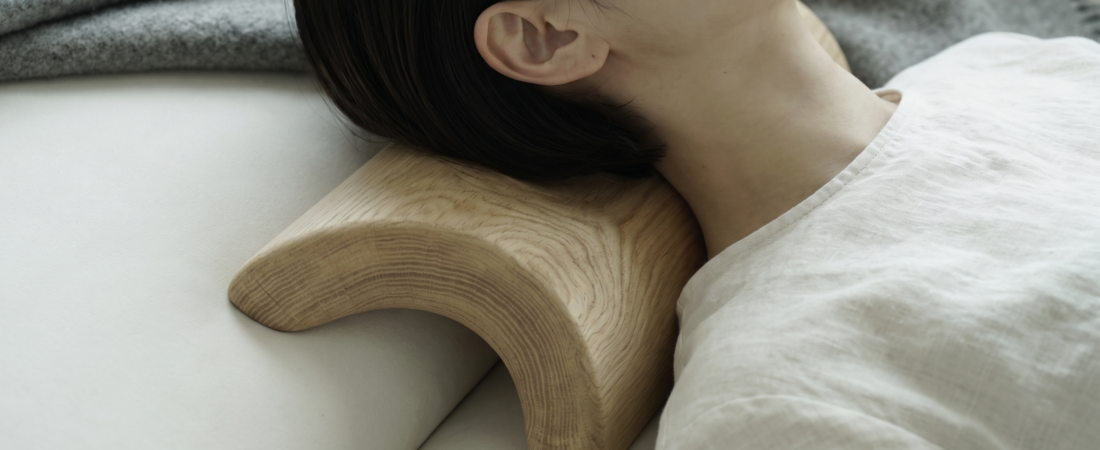
The first time I lay my head on a mokchim, I lasted about ninety seconds before I sat back up. It’s solid wood, curved just enough to fit the back of your neck, and there’s nothing soft about it. My first thought was honestly something like, people pay money for this?
What A Mokchim Actually Is
A mokchim is a traditional Korean wooden neck support, the kind you’d have seen tucked in the corner of a grandmother’s room without thinking twice about it. I’d mentioned it briefly in an earlier post about the workout that finally stuck for me at 45, but I hadn’t gone into why I started using it in the first place. It came down to headaches and eye strain that had gotten bad enough by my late 40s that I was reaching for painkillers most afternoons, especially after a day spent looking at screens.
It’s not a new invention or a wellness trend dressed up in Korean packaging. It’s an old household object that happens to work on exactly the muscles that tense up from modern desk life, which is probably why it hasn’t disappeared the way so many other traditional tools have.
What To Look For If You’re Buying One
Mokchims usually come in a few different woods, most commonly cypress, cedar, or plain hardwood, and the wood itself matters less than the shape. What you actually want is a curve that matches the base of your skull and upper neck rather than a flat block, since a flat surface just presses on one spot instead of distributing pressure. Some come with a light aromatic scent from the wood, which is pleasant but not the point.
Sizing is usually based on height, with most sellers offering small, medium, and large versions. If you’re not sure, medium is the safer starting point for most adult women. Prices range widely, anywhere from budget versions to nicer handcrafted pieces, and in my experience the mid-range ones do the job just as well as the expensive ones. You don’t need to spend a lot to get the benefit.
What It’s Actually Like To Use
I didn’t sleep on mine, and I don’t recommend that either. What worked was sitting on the floor, placing the curved part against the base of my skull and upper shoulder blades, and gently rocking my head side to side for a few minutes. The hardness that had put me off at first turned out to be the whole point. It applies steady pressure exactly where tension actually builds up, in a way a soft pillow just can’t.
I use it two to three times a week now, usually in the evening when my shoulders have crept up toward my ears from a full day at the computer. Five to ten minutes is enough. Any longer and it starts to feel like too much of a good thing, and there’s no real benefit to pushing past that.
It’s also worth knowing this isn’t a passive tool the way a heating pad is. You have to actively position yourself and move, which took me a few tries to get right. The first several sessions I kept placing it too high, right at the back of my skull instead of where my neck meets my shoulders, and it just felt uncomfortable without doing much. Once I found the right spot, the difference was immediate.
My Experience
It took a couple of months before I noticed a real difference, not a dramatic one, just fewer afternoons reaching for the painkiller bottle. My eyes also felt less strained by the end of a workday, which I hadn’t expected the pillow to touch at all. What actually convinced me it was doing something was when a friend commented that I looked less tense around my shoulders, without me having said a word about what I’d been doing differently.
I’m glad I didn’t stop after that first ninety seconds. The discomfort at the start wasn’t a sign it was wrong for me. It was just wood, doing exactly what wood does, before my body had a chance to adjust. If I’m honest, there’s still the occasional evening where I lie down, feel that first hard press against my neck, and briefly remember why I almost quit. I use it anyway.
What To Watch For
If you have an existing neck or spine condition, check with your doctor before trying this, and start with just a minute or two, maybe with a thin towel between your neck and the wood the first few times. Not everyone’s neck curve or sensitivity is the same, and pushing through real pain isn’t the goal here. If something feels sharp rather than firm, stop and reposition rather than pushing through it.
A quick note: I’m not a doctor, and nothing here replaces a conversation with one.
Have you ever stuck with something uncomfortable long enough for it to actually pay off? If you try a mokchim, give it more than one sitting before you decide it’s not for you.